The Chew Shall Inherit: Why America Is Suddenly Obsessed With Thick Noodles
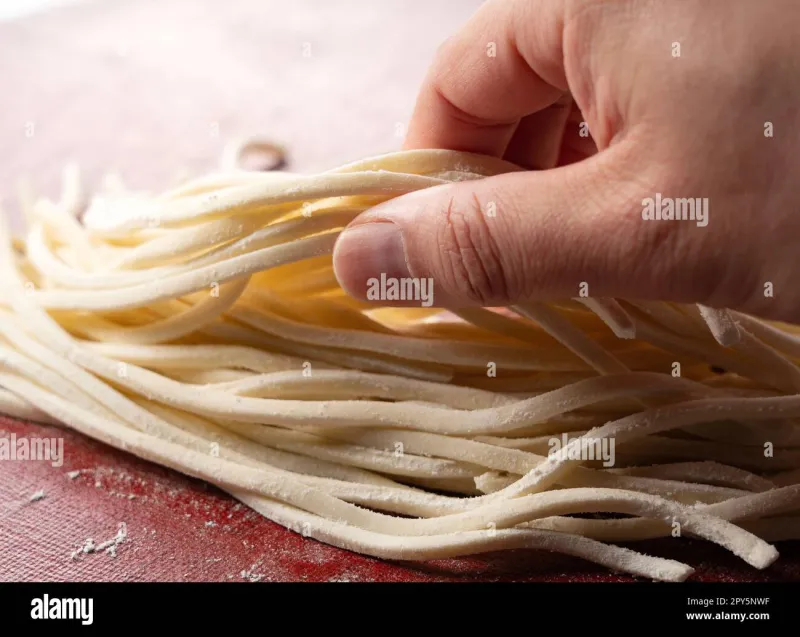
Photo: fresh thick udon noodles being pulled by hand close up, via c8.alamy.com
Somewhere between the tenth million-view noodle pull video and the udon shop opening in your strip mall, it became official: America has a texture crisis, and the cure is a noodle you could bench-press with. Thick noodles — udon, jjolmyeon, kal-guksu, the glorious slab of starch known as cacio e pepe's tonnarelli — are everywhere, and we at Number Nine Noodles are not mad about it. We're investigated about it. So we dug in.
The Noodle Pull Heard Round the World
The thick noodle moment didn't come out of nowhere. Korean fire noodle challenges made chewy, sauce-clinging jjajang-style and buldak noodles a rite of passage for every teenage YouTuber with a webcam and something to prove. Meanwhile, the Japanese "noodle pull" — that hypnotic stretch of fresh udon being kneaded, folded, and tugged on camera — became ASMR catnip for an entire generation. There's a reason those videos have billions of views: watching dough become noodle is the food content equivalent of a campfire.
Then the restaurants followed. Udon-focused chains and fast-casual concepts have been expanding across the US, and even Italian kitchens are leaning in — because anyone who's had a properly chewy pici or a hand-rolled biang biang noodle knows the truth: thin is a flavor, but thick is a feeling.
We Asked an Expert About the Chew
"Q-ness" — the Chinese concept of an elastic, bouncy, satisfying bite — is the entire point, according to Chef Marisol Vega, who runs a hand-pulled noodle program in the Pacific Northwest. "When customers try a fresh thick noodle for the first time, they go quiet. That silence is the q-ness hitting. Thin noodles carry the sauce. Thick noodles are the experience."
She credits the chew to hydration and gluten development — thick noodles are typically worked harder and cut wider, so every bite has resistance. "Resistance is the reward," she says. Honestly, that belongs on a poster.
The Science of Why We Can't Stop
Chewiness isn't just fun — it's satisfying in a measurable way. Foods with more resistance slow down your eating, increase satiety, and frankly, give your jaw something to do besides grind your teeth at the news. There's also the aroma factor: a thick noodle holds heat longer, which means every slurp carries more smell, and smell is where most of flavor actually lives.
The Number Nine Thick Noodle Power Rankings
We taste-tested our way through the thick noodle landscape so you don't have to (you should anyway). Our rankings:
1. Fresh udon — The undisputed champ. Pillowy, bouncy, and perfect in a simple kake broth. If it's handmade, drop everything.
2. Biang biang noodles — Belt-width, ragged-edged, and built to carry chili oil and cumin pork like a freight train. The texture is life-changing.
3. Kal-guksu — Korean knife-cut noodles in anchovy broth. Rustic, chewy, criminally underrated in the US.
4. Pici — Tuscany's thick, hand-rolled spaghetti. Ragù clings to it like it's afraid of falling off.
5. Jjolmyeon — Springy, spicy, served cold. The chew is aggressive and we respect that.
6. Tonnarelli — Rome's egg-yolk-rich answer to udon. Cacio e pepe's true soulmate.
The Verdict
2025 belongs to the thick noodle, and honestly, it earned it. Thin noodles will always have a place in our hearts (and our pho), but the chew is where the culture is heading. So the next time a menu offers a choice, go wide. Go thick. Go quiet with that first bite — Chef Vega will understand exactly what happened.